30 things to do in São Paulo

Valuable tips from Jenna Francisco with her outsider/insider vision about São Paulo city and its attractions: 
- from thisismyhappiness.com
a.k.a. “reasons to get inspired to visit São Paulo” because this is one cool city! If you are looking for things to do in São Paulo, this list is a great place to start. I started to travel to São Paulo in 2000, to visit my then-boyfriend, a São Paulo native who had returned to Brazil after living in the U.S. for one year. That guy later became my husband, and the last 13 years have included annual visits to Brazil to spend time with his family. With locals showing me around, I have an “insider’s view” of sorts.
Despite all these visits, I haven’t even scratched the surface of things to do in São Paulo, especially when it comes to the city’s amazing nightlife (hey, I have two kids!). Besides some serious nightlife, the city is also known for food, markets, architecture, and museums, all of which you will find in the tips below. However, one tip I want to mention but didn’t add since I haven’t done it is the Ciclofaixas de Lazer, or “leisure cycle lanes,” that open on Sundays from 7 a.m. to 2 p.m. and include places to rent bikes. These 30 km of car-free biking paths are on some of the city’s best streets and connect to city parks.
sao paulo houses
The view from my sister-in-law’s apartment


For the average visitor, it can be hard to know what to do in São Paulo. It’s not the most tourist-friendly city because it’s spread out, parts of it are unsafe, and it doesn’t have one central location where all the action can be found (unlike the beaches of Rio, for example). However, the following list will give you some great ideas of what to do in São Paulo, especially if you want what the locals might enjoy and what is not going to break the bank.
30 Things to Do in Sao Paulo, Brazil, the largest city in South America

Culture, Architecture, Museums, and More

1.  Samba Saturday

This is a must! Live Samba music is played in many of the city’s bars on Saturdays. Eating lunch, having drinks, and dancing to live Samba is a way for Paulistanos to relax after a busy workweek. The best place to experience live Samba and traditional Saturday food (feijoada) is Bar Samba in Vila Madalena. It opens around 1:00-1:30 p.m. and stays open until late at night, but get there early to get a table and eat their excellent feijoada (the traditional Brazilian feast of beans, rice, dried meat, kale, farofa, and oranges). The interior is an old house that was converted and decorated with colorful painting on the walls. The crowd is fun, but remember–don’t bring your inhibitions. Instead, talk to people, try the various caipirinhas, and dance!

2. MASP (Museu de Arte de São Paulo)

MASP
São Paulo has many great museums, but MASP is the city’s best art museum. It holds the finest collection of Western art in Latin America and hosts fantastic temporary exhibitions.  Tuesdays are free to the public, but coming here on a Saturday is fun, as you can see in #3 below:

3. Antiques + Handicrafts + Street food

antiques market Sao Paulo
On Saturdays, the area around MASP on Avenida Paulista hosts two great outdoor markets. The space under the museum becomes a huge antiques market, and the space across the street is a handicrafts market where great street food is sold.
street food brazil

Cashew juice and an esfiha: hot bread stuffed with escarole and cheese

4.  Experience the city’s nicest architecture

niemeyer sao paulo

One of Niemeyer’s many gravity-defying designs, this space is used mostly by young people in Ibirapuera park. 
Photo credit: Wallyg on Flickr

One of the 20th century’s greatest architects, Oscar Niemeyer, was Brazilian, and there are several places where you can see his work in São Paulo. The most striking features of his work are curving lines (which he likened to a woman’s body) and creating the effect of defying gravity. These interesting buildings are a nice break from the seemingly endless white apartment towers so typical of São Paulo. Specific places to see his work follow (see #5, 6, 7, 16), but besides modern architecture, the city has some nice, if run down, examples of colonial and historic architecture.

5.  Parque Ibirapuera

things to do in São paulo
Ibirapuera Auditorium, designed by Niemeyer; photo credit Ndecam on Flickr.

Parque Ibirapuera is the city’s largest green space and one of the largest city parks in Latin America. There is plenty to do here…paths to walk or bike or people watch, museums, Niemeyer architecture, a lake, and more.

6.  Museu Afro-Brasil

Museu Afro Brasil
This is one of the nicest museums in the city, which is saying a lot because São Paulo has several excellent museums. It is housed in another Niemeyer designed building. When I was there, the information was only in Portuguese, but even if that’s still the case, the exhibits of the history of African culture in Brazil are fascinating.

7. Latin America Memorial

Latin America Memorial
The blood of Latin America, honoring the sacrifices and struggles of its people

The Memorial da América Latina is a complex of buildings designed by Niemeyer to honor the struggles of the Latin American people and provide a place where celebrations or public events can take place. The buildings include a library, research center, displays of art including Latin American folk art, and the Brazilian Center for Latin American Studies. It makes a nice place to walk around and notice the interesting features of the architecture, but be sure to go inside the buildings if possible.

8.  Pinacoteca do Estado

museum sao paulo pinacoteca
Another lovely museum in São Paulo, the Pinacoteca houses a huge collection of Brazilian art that serves as a visual story of the country’s history and cultural evolution, as well as a nice collection of 19th century French sculpture. The museum has a beautiful café downstairs and is connected to Parque da Luz, a public park that includes outdoor sculptures and a European-style garden area (that are shared with some unusual characters).

9. Soccer Museum

 soccer sao paulo
The Museu de Futebol is located in Estadio Pacaembu, one of the city’s largest soccer stadiums. If you love soccer, you will enjoy the vintage soccer displays, interactive exhibits, and celebrations of World Cup history and Brazilian soccer stars. As you exit, there is a nice gift shop and a café with live music on most weekends. Admission is about $3 and the museum is open Tues.-Sun.

10.  Benedito Calixto all-day market on Saturdays
art market sao paulo
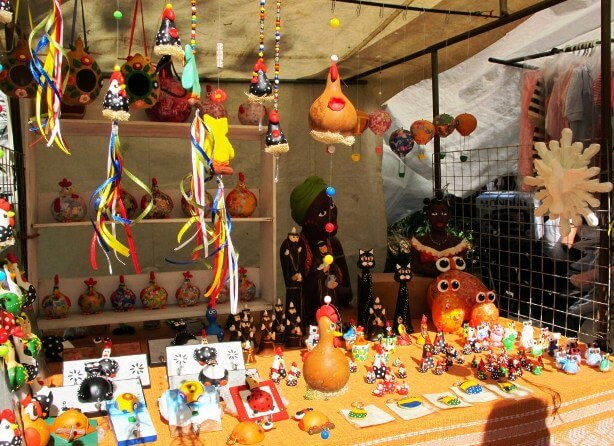
Besides Samba Saturday (see #1 above), this is my favorite thing to do on Saturdays in São Paulo. The Calixto outdoor market goes all day on Saturdays, with antiques and handicrafts vendors starting in the morning and live music and dancing starting around noon in the market’s central food court. The live music is chorinho, a very Brazilian style of music that is samba-influenced, and many people go to the market just for this.
street food brazil
The food court sells dried fruits, nuts, coconut water, acarajé and other traditional food from Northeastern Brazil, traditional Brazilian sweets, and healthier versions of esfihasand other traditional Brazilian snacks, including a whole-wheat esfiha stuffed with escarole and tofu.
Brazil SP 2012 038
The area around the Calixto market is fun to explore. The streets that immediately surround the market have quirky shops and small restaurants, and the nearby street Teodoro Sampaio is full of shops selling traditional Brazilian instruments (fantastic!).

11.  Street art

street art sao paulo

A large mural by Rui Amaral, a multimedia artist and leader of the city’s street art movement.

São Paulo is considered one of the best cities in the world for the development of creativity in street art. The city’s streets are filled with wonderful examples of street art, especially in the city center, but for some of the best, visit the area of Vila Madalena (see #19), especially Beco do Batman (Batman’s Alley), off Rua Harmonia just before Rua Luis Murat.

12. Ipiranga

what to do Sao Paulo Ipiranga
Ipiranga was built in 1895 to preserve 400 years of Brazilian history and houses old maps, photographs, paintings, and furniture. It is located inside an impressive Neo-Classical palace with European-style gardens. Unfortunately, Ipiranga is located far away from the center but is accessible by bus and metro.

13. Butantan


Butantan
One of the largest biomedical research facilities in the world, Instituto Butantan was founded in 1901. It is open to the public and provides a nice place to walk, see snakes in the serpentarium, and learn about the development of vaccines and anti-venom.

(Downtown)

14. Municipal Market

municipal market sao paulo

Caju fruit for sale at the Municipal Market. Photo credit: Wallyg on Flickr

The huge municipal market in downtown São Paulo is not to be missed, partly because it is housed inside a lovely neo-classical building with stained glass windows, but also because of the array of food sold there. In the area around the market, be safe–don’t bring valuables with you, and keep a close eye on your belongings. It is not far from #15 and #16 below, and the nearby streets are run down but include many of the city’s grand old buildings.

15. Praça da Republica Market on Sundays
live music in Brazil
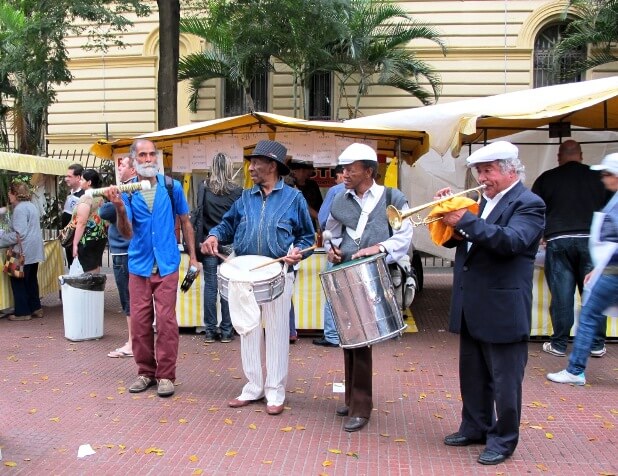
One of the largest outdoor markets in São Paulo, this one is full of artisans and a nice selection of food vendors selling freshly made treats from Northeastern Brazil. There are small tables where you can sit with your snack and drink and enjoy live music. The market takes place in the square surrounding one of the city’s beautiful old buildings. If you come by subway, get off at the Republica station.

16.  Copan

sao paulo architecture
Another of Niemeyer’s famous designs, Copan is a well-known image of São Paulo because of the tall building’s characteristic curve. It is actually an apartment building that has been home to many wealthy and artsy Paulistanos but has become more run-down over the last couple of decades. It’s worth a look, but an even better option is to visit the nearby Italy Building (Edifício Itália) and go to the top floor Terraço Itália restaurant for a panoramic view of the city, including Copan, especially at sunset. Access is free Monday-Friday 3:00-4:00, but you may have to pay a cover charge and buy a drink if you go at other times. My husband’s father was the manager of this restaurant, so I have heard many stories about it.

Cool Neighborhoods & Streets

17. Avenida Paulista

Avenida Paulista
Avenida Paulista is the city’s grandest boulevard, filled with a fun mix of historic and modern buildings and plenty of shopping, nightlife, museums, and a native forest in Parque Trianon (across from MASP, #2 above). The world’s largest gay pride parade takes place here in May/June. It’s also supposedly the most expensive real estate in Latin America. The whole avenue runs along a subway line and is therefore easily reached by public transport.

18.  Stay on Alameda Santos

Next to Avenida Paulista is Alameda Santos, a bit less busy but a central location for renting an apartment through Homeaway or a similar site.

19. Vila Madalena

vila madalena

A block party in Vila Madalena. Photo credit: Fora do Eixo on Flickr.

Vila Madalena is an artsy neighborhood with nice art galleries, arts & crafts shops, and bookstores and with great nightlife in its restaurants, corner bars, and botecos (small bar/restaurants). Come here for samba, as mentioned in #1 above, or just mingle with locals enjoying live music and petiscos (tapas) at the botecos.

20. Bixiga

Preparing food with Italian traditions in Bixiga. Photo credit: Andrea Matarazzo on Flickr.

Preparing food with Italian traditions in Bixiga. Photo credit: Andrea Matarazzo on Flickr.

Brazil is home to the largest population of Italians outside of Italy, many of whom are centered in São Paulo because their ancestors came to work the coffee plantations of the interior of São Paulo state. If you are into food, don’t miss the restaurants in this neighborhood.

21. Liberdade

liberdade Sao Paulo
Brazil has the largest number of Japanese living outside Japan of any country in the world, and many of these Japanese Brazilians live in São Paulo. The Japanese neighborhood, called Liberdade, is a fun place to explore and see how the influence of Japan has influenced Brazilian life here and, of course, try some great food. On Sundays, an enormous market takes place in the public square of Liberdade, and thousands of people from around the city attend.

Food

22.  Alcabarra or another vegetarian restaurant

vegetarian restaurant sao paulo

The delicious vegetarian buffet at Alcaparra

Brazil is more known for its beef and pork, but there are many good vegetarian restaurants in São Paulo. Many of them are buffet style and offer vegetarian and vegan dishes and natural juices. A small one that I like is Alcaparra, at Av. Pompéia, 2544, but Apfel in downtown and Asparagus off Avenida Paulista are also good.

23. Churrascaria

churrascaria sao paulo

No visit to Brazil would be complete without eating at a good churrascaria. Expect lots and lots of food! The price of the meal includes all the food you can eat but not the drinks or desserts. The meal usually begins with various appetizers arriving at the table and continues with the salad/sushi/hot dish bar; soon after, Gaucho-dressed waiters, known as passadores, visit the table with various cuts of beef on huge skewers. You can point to the place where you want them to cut the meat or let them know that you do not want any. Chicken hearts, sausages, grilled pineapple, and grilled fish are usually served as well.

24.  Drink coffee

coffee in Brazil
Though Starbucks has become trendy among the rich in São Paulo, Brazilian coffee is the real deal here. In fact, Brazil is the world’s largest producer of coffee, and if you watch the locals, you will see that they drink plenty of it, too. Stop at a café or padaria and order acafezinho (espresso), cafe com leite, or cafe pingado (hot milk with a shot of espresso added to it, slightly stronger than cafe com leite). I don’t recommend ordering cappuccino because chocolate is added, unless you like coffee that tastes like chocolate.

25. Neighborhood markets

Sao Paulo markets

No matter where you are staying, ask where the nearest feira (outdoor market) is. Small neighborhood markets make a perfect place to not just buy fresh produce but also get an up-close view of the beautiful displays of fruits, veggies, eggs, and other products, usually arranged perfectly on tables covered in colorful striped tarps. I love the care that goes into these local pop-up markets.

26. CEASA

ceasa

Photo credit: LilliDiver on Flickr
CEASA (pronounced say-ah-zah) is the food market to visit in Brazil. It covers 7.5 million square feet and is one of the largest food markets in all of Latin America. You will see beautiful displays of every variety of fruit imaginable from Brazil and beyond. This is where my husband spent his Sunday mornings shopping with his mom. Open Wednesday, Saturday, and Sunday. CEASA is a bit out of the city center and is probably most easily reached by taxi.
CEASA also hosts the largest flower and plant market in Brazil on Tuesday and Friday mornings (it’s finished by 10:30, so get here early) in the MLP Pavilion of CEASA.

27.  The best Brazilian snack: pastel

pastel
Pastel (plural = pasteis) is a deep-fried dough stuffed with your choice of filling, from “pizza” (tomato, basil, and cheese) to ground beef or palm hearts. Look for pastel sellers at outdoor markets or at pastelerias, common on the streets of São Paulo.

28. Eat at a padaria

Sao Paulo cafe
Padarias, or bakeries, are like the daily cafés of Brazil. Brazilians flock here in the morning for excellent coffee, a quick breakfast, and juice. They may also stop in at lunch or in the evening for pizza, fresh pao de queijo (hot cheese bread), or a meal (some padarias offer buffet food por kilo, or by the kilo).

29.  Drink coconut water & visit juice bars

coconut water brazil
Drinking coconut water is a normal part of most Brazilians’ routine, and it’s available all over the streets of São Paulo. Look for guys selling it on street corners, from vans like the one below, or at outdoor markets. It’s a great way to hydrate on a hot day. Also worth trying (a few times) are the enormous variety of juices available at juice bars. Don’t be surprised if they ask you if you want sugar in your juice; many juices are made from frozen pulp of fruits from the Amazon, and they are sour without the addition of sugar.

30. Pizza

sao paulo pizza
Paulistanos love to eat pizza, and their pizza is good! You can order it from the neighborhood pizzeria to pick up or for delivery. Though it’s not exactly cheap (almost nothing in São Paulo is!), it makes an easy and reliable meal. My favorite is “rucola” (above): arugula with sun-dried tomatoes and kalamata olives.
I hope these ways to experience the culture, markets, and food in São Paulo help you if you’re visiting the city or inspire you to learn more about the largest city in South America (and one of the largest cities in the world). São Paulo definitely has its problems, but it is a vibrant city that is on its way to becoming a real tourist destination.

Posted by Eliana Souza - SPin Brazil Tours - with authorization from Jenna Francisco

Ferrari, the mythic piece of art

When we talk about experience in tourism it seems that we have a vague understanding of what it would represent for the tourist. For some a real experience could be described as an accurate mix of numerous details that provoke a explosion of sensations.

A good example is a visit to the city of Modena, close to Bologna, one of the weighty centers of the automotive industry in Italy. Although the neighborhood is home of several car manufacturers like Pagani, De Tomaso and Maserati, the sparkling star is the presence of the mythic Ferrari factory and its unbelievable museum located in the nearby Maranello.

                                        The historical first factory with  terracota tiles and logo - photo by Eliana Souza

Focused entirely in details to empower the Ferrari brand, the museum has the merit of offering either technical information or entertainment to tourists and fans in a funny way. The attention of the visitors is often grabbed by the precise use of the space and the creative style the masterpieces are displayed.


                                                                         Ferrari museum - entrance - photo by Eliana Souza

simulator for virtual driving  - photo by Eliana Souza

models from different phases and periods - photo by Eliana Souza

La Ferrari - photo by Eliana Souza

The cherry of the cake is the Victories Hall where the F-1 super Ferraris are in exhibition. Like a championship room this one leads you to the Grand Prix environment and makes you feel like a racing driver. 


The Formula I cars at Victories Hall - photos by Eliana Souza

The factory and track tour taken in a exclusive bus is a good complement of the visit. However it should be booked in advance and can be taken only in two times: 12:30pm and 1,30pm. As photos and video shootings are not allowed, the visit stirs the tourists imagination much more and contributes to reinforce the mythic aspect around the prancing horse brand. 


Interactivity, astonishment, content in the right – who needs more to dream with a Ferrari? Nevertheless it can go beyond. Around the museum there are companies where you can try a real short driving experience to feel like a priviledged owner. Models like the F430 or F458 can be rented per hour.


Ferraris parked and waiting for visitors interested in driving experience - photos by Eliana Souza

When the instructor guides you for the right streets in the surroundings teaching you how to operate the shift sticks in the steering wheel of the convertible California, you will feel in heaven.  When he orders you to push the accelerator and you listen to the sound of the powerful engine, you instantly understand why Ferrari well succeeds on arousing passion and raising emotions. At least for some seconds you can observe the other drivers in ordinary cars looking at you with envy and respect. It is just a dream, however you smile and promise to yourself that you will certainly come back.

If you have short time, but is crazy by speed, take the opportunity to explore the region in a full-day tour including Ferrari, Lamborghini and Ducati motorcycles factories, offered by Motorstars (www.motorstars.org). Francesco Bini, a former employee of Ferrari, can pick you up in a comfortable premium van, book the visits and select the best content to surprise you and make your experience really unforgettable.

Ferrari museum: http://museo.ferrari.com
Dino Ferrari 43, in Maranello, around 18 km from Modena, Italy


Eliana Souza - SPin Brazil Tours

Pope and the Our Lady Aparecida Basilica


Pope Francisco, the first South American Pope


Pope Francisco will arrive in Brazil tomorrow, July 22nd. On Wednesday, July 24th, he will visit arrive in Aparecida, a city located 168 km northeast of São Paulo city, in the State of São Paulo, and 240 km southwest of Rio de Janeiro.
Aparecida has about 3500 inhabitants and gets used to receive pilgrims and Catholic tourists  considering it is a religious city where it is settled Our Lady Aparecida Basilica.  Eleven million pilgrims visit the city and the sanctuary annually.

Thousands of young Catholics from all over the world, pilgrims and Brazilian people will be there waiting for the Pope blessing and curious to see him very close. The landing of the helicopter that will bring him from Rio is scheduled for 9:25 am. In land the pope will take the popemobile and surround the sanctuary slowly to greet the faithful. After a quick brake the pope will celebrate the mass at Our Lady Aparecida Basilica. He will take the popemobile again for another circuit that will cross several streets inside the city on the way to the Seminary of Good Jesus. There the Pope Francisco will have a private lunch with his delegation and local religious. Even the menu of the lunch is kept in secret. A special comfortable room has been reserved for the Pope to rest and pray. On 4:10 pm the helicopter flight is scheduled to depart to Rio, where the Pope will be waited to take the way to visit the hospital Saint Francis of Assis at Tijuca neighborhood.    


Our Lady Aparecida Basilica, general view, photo by wikipedia

Our Lady Aparecida Basilica, photo by architect Eduardo Faust

Our Lady Aparecida Basilica was inaugurated in 1967 to replace the old church in colonial style of the nineteenth century, located inside the city. It is dedicated to our holy Lady Aparecida,  considered the Patroness of Brazil. The project was made by the Brazilian architect Benedito Calixto in Romanesque style which takes the form of a Greek cross. Its monumental size, with capacity for 45000 people, loses only for the Saint Peter Cathedral in Vatican.


Our Lady Aparecida Basilica, side view, photo by Rodrigo Soldon 

Our Lady Aparecida Basilica, arches, photo by Rodrigo Soldon

 Our Lady Aparecida Basilica, interior, photo by Rodrigo Soldon 


Our Lady Aparecida Basilica, high altar, photo by Rodrigo Soldon 

Our Lady Aparecida image


The story of Our Lady Aparecida dates back to the beginning of eighteenth century when three fishermen where trying to get fish at Paraiba River. Although they were unsuccessful, they kept trying until they rescued a body image. Just one of them kept trying and finally he rescued the head of the image. After that, fishes seemed to jump into the boat. The episode was considered a miracle by the local population. The fisherman fixed the image carefully and has kept it for decades at home, where people came to pray and spread out the news about the saint. Later the family built a shrine to the saint. As the number of believers just grew up it was necessary to build a larger church, which was the old basilica. 

 
 Our Lady Aparecida Basilica, miracle room, photo by Rodrigo Soldon 

The miracle room is a evidence that a huge number of faithful come to Our Lady Aparecida  Basilica in order to fulfill their promises, after their graces are achieved.  It is interesting to observe the number of objects related to health, like legs, arms, heads, hearts, etc as well as personal ones  like clothing and documents.  

Catholicism and catholic churches in São Paulo

Considered the country with the largest number of catholics in the world, Brazil has a huge number of catholic churches built in different periods in several architectural styles and ran by different religious orders.

The city of São Paulo is no exception and has relevant churches located all over the city, that are attended by its multicultural population.

Se Cathedral, located at old downtown  


Se cathedral facade- photo by Percival Tirapeli


Se cathedral, cript, photo by Eliana Souza

Although it seems to be older, the Metropolitan Cathedral was inaugurated just in 1954 for the 4th centennary of the foundation of São Paulo. It is located in the center of the city at Sé square.

The construction took  more than 40 years and it was projected by the German architect Maximilian Hell. With a mix of architectural styles that goes from the neo-gothic to the Renaisssance influence, the cathedral replaced the former one in colonial style.

All the marble used in the construction as well as the mosaics, sculptures and furniture were brought from Italy. It also worths to admire the magnificent colouful stained glasses made by renowned European artists, like the French Max Ingrand.

Beneath the high altar, a large cript keeps tombs of prominent figures of the Brazilian history and of all bishops and archbishops of São Paulo.


 Church of the Third Order of Carmo


Church of the Third Order of Carmo - interior - photo by Percival Tirapeli

Very close to the cathedral. the modest church of the third order of Carmo was built by a group of lay people, descendants of the pioneers of the city, in the seventeenth century.

It is considered an important historical and religious heritage as it holds a significant set of colonial art from São Paulo. The high altar in wood and the paintings in the ceiling are examples of baroque art work.
It still keeps the original walls that have been constructed with the technique known as "taipa de pilão",   introduced by the Portuguese.


Monastery of the benedictines, located at old downtown - photo by Eliana Souza

The main entrance of the church of the benedictines - photo by Eliana Souza


Church of the benedictine monastery - interior - photo by the monastery

Room prepared for the brunch at the benedictine monastery - photo by the monastery

An icon of the city,  the monastery of the benedictines was rebuilt when São Paulo received the German priest D. Miguel Kruse in the beginning of the twentieth century. He was responsible by the revitalization of the religious order after its decline at the end of the former century. Under his supervision the complex of church and monastery was redesigned and regained its position of historical importance.

After the demolition of the old colonial church built in the sixteenth century, a new construction was made following the Beuron art school trends, that mixes Egyptian, Bizantine, Romanesque and Celtic Arts. The result is a magnificent interior with work of art from important European artisans and artists like the Dutch monk Adelbert Gressnicht. The discreet facade boasts a huge clock coming from Germany that was famous for its accuracy. Another attraction is the organ, manufactured by the Spat family company.

For decades the monastery has also housed a conservative school, just for boys, where children of traditional Brazilian families of São Paulo have been educated.

In 2007 it called attention national and internationally, when it hosted Pope Benedict XVI during his visit to Brazil.

Several people come often to listen to the Gregorian chants perfomed during the Sunday mass by the monks, who live and work at the monastery. Nowadays there is a special tasty brunch offered to the visitors twice a month after the mass, that should be booked and paid in advance. 


Saint Anthony´s church - photo by Dornicke (wkipedia)

Side altar in Saint Anthony´s church - photo by Percival Tirapeli

The Saint Anthony´s church is considered the oldest one remaining in the city. Although its foundation date is uncertain, according to historical documents the church was built in the sixteenth century when the Portuguese catholic missionaries arrived in São Paulo.

Located in the square of the patriarch, old downtown, the modest church was renovated in 2005. Its interior still keeps preserved altar pieces and art works from the colonial period with paintings dating from the seventeenth century and elaborated baroque carvings.

Saint Anthony is one of the favourite saints of the Brazilian community, particularly among the women.
Like in other countries of the world, he is considered the only saint who can help single ladies to find the true love. There are several  popular rituals that involve him such as keeping the saint upside down till the grace is reached.


Saint Francis of Assis church and convent - photo by Eliana Souza


Saint Francis church - side altar - photo by Percival Tirapeli


Law University of São Paulo - photo of public domain

The humble convent and Saint Francis church is one of the best preserved colonial structures in the city.

Located in the west side of the cathedral, it stays next to the Law University, considered one of the most important educational institutions in the country, where distinguished  poets, writers, artists,and politicians have graduated.

The construction from the seventeenth an eighteenth centuries still keeps the original thick walls made with the technique named "taipa de pilão", introduced by the Portuguese.

Next to this church there is another one named Wounds of Seraphic Father Saint Francis, which is still in restauration process. It was originally a chapel built in the seventeenth century. It is a classic example of baroque art and architecture with gold-plated panelings and the largest set of paintings in rococo style made by the important painter José Patricio da Silva Manso.


Sacred Art Museum - entrance

Sacred Art Museum and Luz convent

The Luz monastery is a masterpiece built in the eighteenth century by Friar Galvão, an artist, architect and constructor, known as the protector of the architects and the workers of constructions in Brazil. He was canonized as the first Brazilian saint by the prior Pope in 2007.

Considering its relevant architecture the monastery has been declared UNESCO Human Heritage.

The building is located close to the Luz Railway Station in Luz neighborhood and also is home of the conceptionist nuns, who live in a cloister until today. They are responsible for making the famous miracle pills of Friar Galvão, considered a holly medicine. Usually the nuns distribute the packets containing three pills to be taken  within a nine-day period. The pills are tiny rice papers with a prayer and should be ingested by those in need. 

The Sacred Art museum is also located here and it is a fantastic opportunity to understand the decisive Portuguese influence and the history of catholicism in Brazil.


Relevant Brazilian artists like Aleijadinho and Priest Jesuíno do Monte Carmlo, who represent the best of the national baroque art, are part of its prominent collection, considered the largest of the country.

In the middle of baroque art works, religious silverware and altar pieces, the chandelier collection is one of the highlights for being the second largest in the world, just after the one that belongs to the Vatican museums.

Next to the building the visitor can admire the Nativity Museum that houses several nativity scenes designed by artists from different regions of Brazil. The Naepolitan nativity scene from the eighteenth century, with more than 1500 pieces brought by the influential Brazilian mecenas Francisco Matarazzo Sobrinho, was assembled in a special room, which is a must.

The Obelisk and July 9th in São Paulo

Surrounding the largest urban park in São Paulo city, named Ibirapuera Park, the projection of a huge monument can be seen.

Aerial view of Ibirapuera park - photo by Prof. Percival Tirapeli


The monument, that consists of an obelisk and a crypt,  was projected by the Italian-Brazilian sculptor Galileo Ugo Emendabili and executed in travertine marble by the German engineer Ulrich Edler. The construction was inaugurated in 1995, just one year after the park was opened. Preserved as historical heritage, the mausoleum of the obelisk guard the bodies of the students killed during the Revolution of 1932 and 713 ex-combatants. To honor them and to preserve the memory of the rebellion, there are biblical scenes and passages in the history of São Paulo made ​​with Venetian mosaics. Engraved in the building it is possible to see the initials MMDC, that corresponds to the names Martins, Miragaia, Drausio and Camargo, the four boys killed in conflicts of the Civil War, which is settled in São Paulo in 1932 and led to the Constitutional Revolution.


The obelisk - photo by Dornicke

In general, the Constitutionalist Revolution of 1932 is seen as an immediate answer to the new direction taken by the national political scene under the command of Getúlio Vargas, who decided to close the National Congress authoritatively.

In the year 1931, the collapse of coffee prices, as a result of the crisis of 1929 - the crash of the New York Stock Market, impacted directly the coffee producers, particularly the ones established in São Paulo State, generating a displacement of peasants to the urban center. Social problems caused by this scenario cooperated for mobilizing much of the population of São Paulo, looking not for the interests of the old conservative politicians but for real democracy.

In May 23, 1932, a group of young students tried to storm the headquarters of a newspaper favorable to the Vargas regime. During the conflict - which had already taken to the streets of São Paulo - students Martins, Miragaia, Drausio and Camargo were murdered by a group of lieutenants. The initials of those involved in the tragic event inspired the preparation of the movement known as MMDC, who advocated armed struggle against Vargas.

These deaths were the spark that started the Constitutional Revolution on July 9, 1932. With the help of the mass media, the movement won popular support and mobilized 35,000 men by the side of São Paulo, against 100,000 soldiers pro-Vargas. It took nearly three months of bloody battles, closed on October of that same year, when São Paulo was isolated and defeated. 

Historical  poster convoking volunteers for the Revolution - photo by Renato Chauí

However, morally, the movement was a winner, considering  the federal government called elections for a Constituent Assembly, which drafted the Constitution of Brazil in 1934. It was also the first time in the country that women participated in the electoral process, according to historians.

CURIOSITIES:

There are several curiosities about the design itself considering the project was based on numerical relationships, which always lead the observer to numbers related to the date of the rebellion: 09.07.1932. 

Aerial view of the obelisk - photo by Petria Chaves

The obelisk is 81 meters high, whose square root is 9. Also the larger base in trapezoidal shape from the floor is 9 meters for whom looks forward to the monument. The smaller base, above, has 7 meters. The width of the crypt, below, is 32 meters. Anyone looking forward to the profile of the plant would have the dimensions 32-9-7, which recall the year, day and month of the start of the conflict. To enter the monument must go 9 steps. From the access, there are three groups of three arches each, totaling 9 arches.

From the outside, the obelisk represents the image of a sword, with four faces, facing each of the cardinal points of the city, planted in a square-shaped heart.


Genesis, by Brazilian photographer Sebastião Salgado


The Brazilian photographer Sebastião Salgado talks about his last project and book named Genesis.
An exhibition about it is taking place at the Natural History Museum in London


Brazilian music in four-hand guitar performance

The amazing four-hand guitar performance of the Duo Siqueira Lima, comprised by Uruguayan Cecilia Siqueira and Brazilian player Fernando Lima.

The popular music is "Tico-tico no fubá", composed by the talented musician and songwriter
Zequinha de Abreu in 1917.